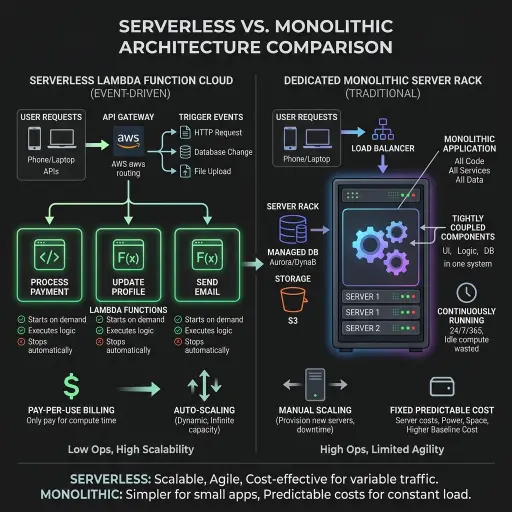
Serverless computing (AWS Lambda, Google Cloud Functions) has revolutionized how we think about deployment. The promise is intoxicating: never pay for idle compute, scale to infinity instantly, and eliminate infrastructure management entirely.
However, as many rapidly growing SaaS platforms discover, adopting serverless without understanding its specific economic and operational boundaries often leads to "The Serverless Trap."
The Cold Start Crisis
Serverless functions spin down when inactive. When a new request arrives, the cloud provider must allocate resources, load the runtime, and execute your code. For lightweight tasks, this "cold start" margin is negligible. But for enterprise applications relying on heavy DB connections, VPC interactions, or large runtime dependencies, a cold start can inject hundreds of milliseconds (or even seconds) of latency. If you are building a real-time system (like trading APIs or high-frequency game servers), serverless will fundamentally cripple your UX.
The Cost Crossover Point
Serverless is cost-effective when your traffic is extremely bursty or consistently low. You essentially pay a premium per-compute-millisecond for the convenience of auto-scaling. As your constant baseline load increases, however, the math flips. A continuously firing Lambda function will quickly eclipse the monthly cost of a dedicated ECS cluster or raw EC2 instances running Docker. We've seen startups burn through funding simply because they routed high-throughput analytics streams through serverless event triggers instead of a dedicated ingestion microservice.
Architectural Fragmentation
When a monolithic architecture is broken down into 400 individual serverless functions, orchestration becomes a nightmare. Tracing an error through a web of API Gateways, SNS topics, SQS queues, and downstream Lambdas requires sophisticated (and expensive) observability tools.
When Serverless is the Right Choice
Serverless shines brightly in the following scenarios:
- Cron Jobs & Scheduled Tasks: Nightly database cleanup, weekly report generation.
- Asynchronous Processing: Image resizing upon S3 upload, webhook ingestion, PDF rendering.
- Irregular High-Burst APIs: Marketing landing pages that see 0 traffic suddenly hit with a Superbowl ad.
Conclusion
At BWS, we advocate for a hybrid approach. Run your predictable, high-throughput core logic on dedicated, containerized orchestrators (Kubernetes/ECS), and offload asynchronous, burst-heavy auxiliary tasks to Serverless environments. Choose your hammer based on the nail.