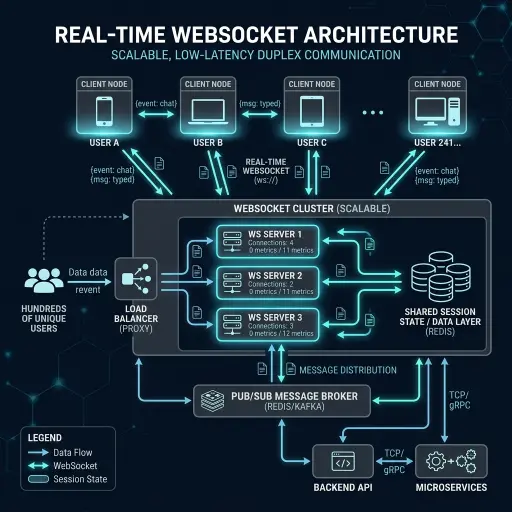
Building a real-time chat app using WebSockets for 10 users is a weekend project. Scaling that same system to handle 100,000 active, concurrent connections broadcasting events globally is an engineering marathon.
Standard HTTP architecture is practically stateless; WebSockets are notoriously stateful. This shifts the entire paradigm of load balancing, deployment, and memory management.
The Stateful Roadblock
When a user opens a WebSocket connection to Server A, that TCP connection must remain pinned open. If Server A crashes or simply deploys a new code version, those users instantly disconnect. Moving them gracefully to Server B requires meticulous architectural orchestration.
Furthermore, standard HTTP load balancers distribute traffic blindly based on round-robin algorithms. If two users are talking, and one connects to Server A and the other connects to Server B, how do they chat? They are essentially in different rooms.
The Pub/Sub Lifeline
To solve horizontal scaling across server boundaries, real-time architectures require a centralized message broker.
When User 1 (on Server A) sends an event destined for User 2 (on Server B), Server A doesn't send it directly to Server B. Instead, it publishes the event to a fast, in-memory data store like Redis Pub/Sub or Kafka.
Every Node.js server in the cluster is subscribed to these channels. When Server B sees an event for User 2 drop into Redis, it grabs it and emits it down its local WebSocket pipe. This decoupled event-bus is non-negotiable for scale.
Managing Connection Memory Metrics
Every open WebSocket consumes active RAM. In Node.js, V8 engine garbage collection can aggressively stall the event loop if you have 30,000 idle sockets hoarding memory contexts.
- Heartbeats: Sockets must implement strict
ping/pongheartbeat mechanisms (every 30s) to aggressively detect and drop dead connections that the operating system hasn't cleared yet. - Horizontal Sharding: Don't vertically scale massive 64-core monolithic socket servers. Run dozens of smaller, highly ephemeral containers. This limits the blast radius; if one node succumbs to an Out-Of-Memory (OOM) error, only 5,000 users experience a 2-second reconnect jitter instead of taking down the entire platform.
Conclusion
Building scalable real-time systems fundamentally means building robust failure-handling systems. Everything centers around the inevitability that stateful connections will drop, servers will auto-scale, and data must route synchronously. By utilizing stateless authentication, robust Redis backplanes, and aggressive heartbeat monitoring, you can build WebSockets that feel completely invisible to the user.