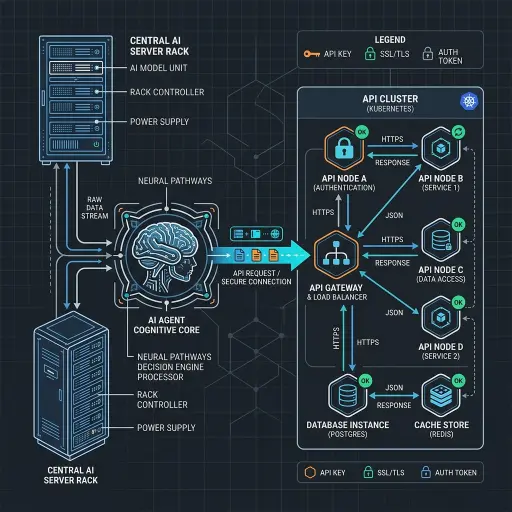
For the last two decades, backend systems have been engineered with two primary consumers in mind: internal graphical user interfaces (web/mobile apps) and human developers (public developer portals).
As we aggressively enter the era of Large Language Models (LLMs) and autonomous agents capable of independent tool-use, the consumer base for your backend is shifting. If your system is not explicitly designed to be natively "readable" by an AI agent, your digital product may become obsolete in the multi-agent ecosystem.
Here is the engineering playbook for building the Agent-Ready API.
The Problem with Human-Centric APIs
Most RESTful endpoints rely heavily on implicit or undocumented context. A human engineer reading a Swagger document can infer that an invite_status field returning [0, 1, 2] roughly corresponds to [Sent, Pending, Accepted].
An LLM agent—attempting to autonomously chain API tools together to execute a dynamic task—will catastrophically hallucinate when guessing what 1 means without precise schema declarations.
1. Extremely Verbose Documentation via OpenAPI/MCP
AI agents heavily leverage structural descriptions to understand how to map their natural language objectives to remote procedure calls.
- Strict Type Definitions: Avoid generic string arrays. Use specific Enums for every distinct state.
- Granular Payload Descriptions: Every individual parameter in your API requires a plain-text human description alongside its type requirement. The agent reads the description to generate intent.
- The Model Context Protocol (MCP): Consider integrating emerging open standards like MCP (spearheaded by Anthropic), allowing external tools to explicitly expose safe, context-rich functions that an LLM client can trigger organically.
2. Predictable, Deterministic Paginators
Agents struggle with variable iteration schemas. They can process vast arrays of data, but if one endpoint uses offset keys and another uses page numbers, tool execution will fail. Standardize all data-returning operations on one definitive limit/offset pattern.
3. Graceful Error Handling Over "Fail Fast"
When an Agent crashes into a "400 Bad Request," it desperately needs contextual recovery data.
A standard error: {"error": "Invalid format"} tells an agent nothing.
An agent-ready error: {"error": "Date format invalid", "expected": "ISO 8601 YYYY-MM-DD", "received": "04-15-2026", "actionable": true} allows the LLM to self-correct in real time and execute a successful secondary loop.
4. Read-Only Scope Defenses
When connecting agents inside enterprise integrations, security scopes cannot rely on interface restrictions; the agent holds raw access. Create hard, isolated API keys restricted to read-only environments when enabling diagnostic LLMs, deploying "sandboxed shadow servers" if needed for complex calculations.
Conclusion
"API-First" has evolved from meaning "system decoupled from the UI" to "system ready for autonomous logic." By building verbose, self-documenting, and explicitly typed backend structures, your platform becomes seamlessly composable for the thousands of AI agents hitting the market globally over the next 36 months.