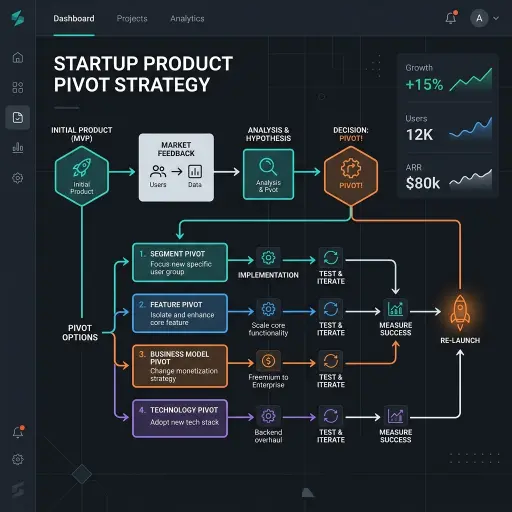
In the fast-paced ecosystem of digital products, the initial idea you fund is rarely the exact idea that ultimately captures the market. Building a platform—whether a niche SaaS, an overarching LMS, or an eCommerce engine—requires embracing evolution.
At BWS, we’ve learned that falling in love with a rigid product requirement document (PRD) can be the fastest path to stagnation. Instead, modern startups must master the art of the Strategic Pivot.
Myth: A Pivot equals Failure
A pivot is often misunderstood as an admission of defeat. In reality, it is a testament to agility. A pivot simply means you have gathered enough authentic user feedback to understand that your current mechanism isn’t delivering the value it promised, and you course-correct before burning out your runway.
Recognizing the Signals
How do you know when it’s time to pivot? There are three unmistakable metrics:
- The "Nice-to-Have" Syndrome If users compliment the interface, log in once, and never return, your product is a vitamin, not a painkiller. High initial acquisition paired with catastrophic churn indicates that you're solving a minor inconvenience rather than a critical business flaw.
- Infinite Feature Validation loops If your core metrics remain flat, but your backlog is overflowing with "if we just add this one feature, they will buy it" requests from the team, you are chasing a ghost.
- The Micro-Market Wall Sometimes the product works beautifully, but the Total Addressable Market (TAM) is much smaller or harder to reach than anticipated. Growth plateaus rapidly.
The Architected Pivot
Once the need to pivot is recognized, how do you execute it without alienating the small user base you do have?
- Drop the weight: Strip the product back to the module that actually generates engagement (often the most unexpected feature).
- Repackage: If the backend logic is strong but the audience is wrong, reskin the SaaS for a new vertical. (e.g., An internal company chat tool pivoted to become Slack).
- Communication: Honesty builds loyalty. Be transparent with early adopters about why the product suite is shifting.
Conclusion
A pivot is not a panic move; it is a calculated bet on new data. By designing software architectures that are inherently modular (like the API-first principles we use at Broadway Web Services), your product can bend without breaking. Stay agile, listen to the data, and build what the market demands.