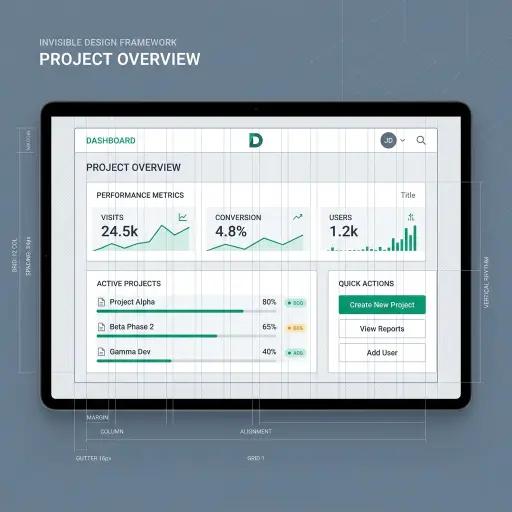
There is a common misunderstanding in digital product development that "design" is something you see. In reality, the most successful designs are ones you don't notice at all. When design is executed perfectly, it becomes a Transparent Framework that allows the content to speak directly to the user.
This is what we call the Content Multiplier.
Design as a Servant to Information
In the early days of the web, design was often used as a layer of decoration—skeuomorphic buttons, heavy textures, and distracting gradients. As the web matured, we realized that users don't visit a dashboard to admire the border radius; they visit to find out if their server is down or if their shipment is delayed.
High-performance design recognizes this hierarchy. Every line, every margin, and every font choice should serve a singular purpose: increasing the legibility and impact of the content.
1. Information Architecture over Aesthetics
Before we open Figma, we define the Information Architecture (IA). We ask: "What is the most important piece of data on this screen?"
If you are designing a healthcare portal, that might be a patient's latest lab result. If you are designing an eCommerce store, it’s the "Buy" button. Invisible design ensures these elements have the highest visual weight, while "supporting" elements (like navigation) fade into the background until needed.
2. The Power of "Negative" Space
One of the hardest things for stakeholders to accept is empty space. "Can we put something here?" is a frequent request. However, white space (or negative space) is the most powerful tool in an invisible design system. It provides the "breathing room" that allows the human brain to process information without feeling overwhelmed.
Designers don't use white space to make things look "modern"—they use it to reduce Cognitive Load.
3. Predictability as a Feature
"Invisible" design is also highly predictable. It follows established UI patterns that users already understand. If a button looks like a button and works like a button, the user doesn't have to "think" to interact with it.
Creativity should be reserved for the Value Proposition, not for the way a scrollbar works.
The Content-Centric Future
As AI-driven interfaces become more common, the role of design will shift even further toward transparency. We are moving away from screens and toward "Conversations" and "Insights." In this world, the "design" is the logic that presents the most relevant content at the most relevant time.
Conclusion
If your users are talking about your "beautiful interface" more than they are talking about your "useful product," you might have a design problem. True design perfection is reached not when there is nothing left to add, but when there is nothing left to take away.
Ready to build a product where content takes center stage? Explore our Product Strategy solutions or see our VOD Video System for an example of content-first engineering.