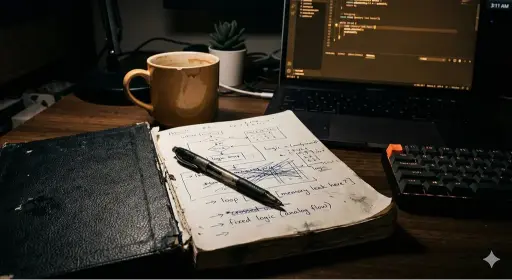
A 3:11 AM revelation on why the best debugging tool isn’t a digital one.
The screen was calibrated to a perfect, dim amber, the kind that’s supposed to save your eyes but usually just reminds you how long you’ve been staring at it. It was 3:11 AM. I was chasing a memory leak that didn’t want to be found, tucked away in a nested loop that looked clean on paper but acted like a poltergeist in production.
In moments like these, the modern developer is supposed to reach for a diagnostic tool, an AI debugger, or a stack of forum threads. Instead, I reached for a beat-up, ink-stained notebook.
The Analog Anchor
There is a specific kind of magic in a physical pen hitting paper. In a world of Ctrl+Z and infinite revisions, ink is a commitment. When I draw a logic flow by hand, I can’t just delete a line; I have to cross it out, leaving a trail of my own "wrong" thinking.
Those messy margins are where the real learning happens.
We’ve become obsessed with “clean” environments. We want our IDEs to be sleek, our desks to be minimalist, and our code to be dry. But creativity is inherently messy. By forcing my brain to slow down to the speed of my hand, I find the gaps that my typing speed usually skips over.
The 3:00 AM Revelation
As I traced the logic with a ballpoint pen, the error jumped out. It wasn’t a syntax error. It wasn’t a bug in the library. It was a human error — a logic flaw born from being too “efficient.” I had tried to automate a process that required a bit more manual nuance.
I sat back, the silence of the house pressing in.
We often talk about “technical debt” as something we owe to our codebase. But there’s also “mental debt” — the exhaustion we feel when we try to operate at the same clock speed as our processors.
Craft Over Speed
The tech industry moves at a breakneck pace. If you don’t learn the newest framework by Tuesday, you feel like a relic by Wednesday. But the fundamentals of storytelling, logic, and human connection don’t have versions. They don’t have deprecation cycles.
I closed the notebook, shut the laptop, and didn’t fix the code until the next morning.
The fix took thirty seconds. The realization took five hours of frustration and one ink-smudged page.
We don’t need more tools to make us faster. We need more moments that force us to slow down. Because at the end of the day, the code is just a reflection of how we think — and sometimes, you can’t see the big picture until you step away from the pixels.