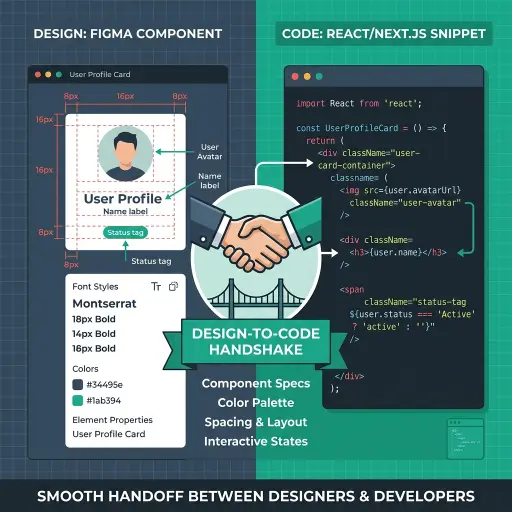
The most common source of friction in a digital studio is the "handover." Designers spend weeks perfecting an interface in Figma, only for developers to receive a link and be told to "make it look like this."
Without a structured Handshake, this process inevitably leads to the Diffusion of Quality: small inconsistencies in spacing, color variations, and missing interactive states that slowly degrade the final product's premium feel.
From Handoff to Handshake
At BWS, we don't believe in "handoffs" (a one-way toss of assets). We believe in a Handshake—a bidirectional collaboration where designers understand constraints and developers understand intent.
1. Token-First Design
The first step in a successful handshake is moving away from ad-hoc hex codes and pixel values. We utilize Figma Variables and Tailwind CSS tokens to create a shared vocabulary.
Instead of saying "make this button #10B981," the designer says "apply the emerald-500 token." When the developer sees this in Figma, they already have a matching variable in their Tailwind configuration. This eliminates "magic numbers" from the codebase and ensures 100% color and spacing fidelity.
2. Component-Driven Thinking
Designers should think in components, not just pages. When a card is designed in Figma, it should account for all its states:
- Default
- Hover/Active
- Loading (Skeleton)
- Error/Empty
- Responsive (Mobile vs Desktop)
By designing the system rather than the screen, the developer can build a robust, reusable React component that handles all scenarios, rather than guessing how a page should look on a smaller device.
3. Living Documentation with Storybook
We leverage Storybook as the literal bridge. It allows designers to review the "real" code components in isolation, testing them with different data and viewport sizes without needing to run the full application. This provides a playground where the Handshake becomes a visual verification process.
The Impact on Engineering Velocity
A strong Design-to-Code Handshake doesn't just improve aesthetics—it dramatically increases speed. When the "how" is already defined by a shared system, developers can focus on the "logic."
Instead of spending 3 hours tweaking CSS margins, an engineer can spend that time optimizing the API fetching strategy or implementing robust error boundaries.
Conclusion
A premium digital product is the result of a seamless transition between creative vision and technical execution. The Handshake is the process that ensures nothing is lost in translation.
Interested in our architectural approach to frontend systems? Explore our Software Development services or see how we bridge the gap in our eCommerce Mobile App case study.