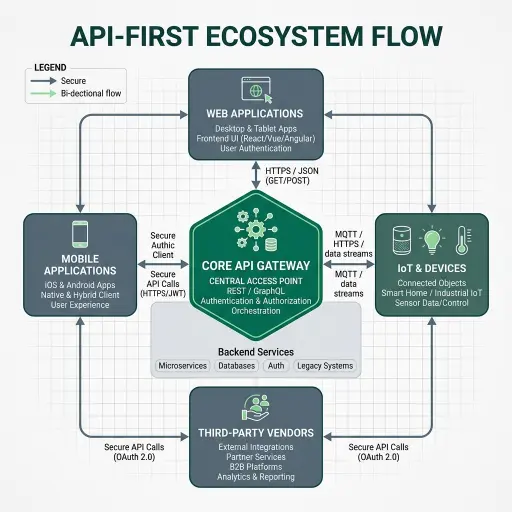
In the fast-moving world of product development, the instinct is often to build the interface first. "Show me what it looks like" is the common refrain from stakeholders. However, at BWS, we argue that the most successful, resilient products start with something invisible: the API Contract.
An API-First approach isn't just a technical preference; it is a strategic advantage that defines whether your product lives in a silo or grows into an ecosystem.
What is API-First?
API-First means that your application's programming interface is treated as a primary product. You design the endpoints, data schemas, and the "contract" between services before a single line of frontend code is written.
This creates a decoupled architecture where the backend logic is completely separate from the consumption layer (Web, Mobile, Third-party integrations).
The Competitive Advantages
Why take the time to design the API first? The benefits are cumulative:
1. Parallel Development (The Speed Multiplier)
When the API contract is finalized (using tools like Swagger or OpenAPI), the frontend and backend teams can work in total isolation. The frontend team mocks the API responses and builds the UI, while the backend team builds the actual logic. When they finally connect, the integration time is reduced from weeks to hours.
2. Omnichannel Readiness
In an API-First ecosystem, your web app, iOS app, and Android app all consume the exact same logic. You don't rebuild "Check Balance" logic three times; you build it once, expose it via the API, and every client benefits. This ensures 100% data consistency across every touchpoint.
3. Partner Interconnectivity
API-First products are inherently ready for the "Platform Economy." When you decide to integrate with a partner (e.g., a logistics provider or a payment gateway), you aren't hacking into your database. You simply provide them with the API documentation. Your software becomes a pluggable node in a larger digital network.
Architecting for Resilience
Resilient APIs require more than just "endpoints." They require:
- Strict Versioning: Ensuring that updates don't break legacy clients (using
/v1/,/v2/paths). - Graceful Error Handling: Providing meaningful error codes (404, 422, 500) that allow the UI to respond intelligently.
- Robust Security: Implementing OAuth 2.0 and JWT-based authentication from day one.
Conclusion
Your UI will change. Trends in design move fast. But your business logic—the way you calculate shipping, manage inventory, or process payments—is the core value of your company. By adopting an API-First strategy, you protect that core value and ensure your product is ready to scale, no matter what the future of design looks like.
Ready to architect a resilient digital ecosystem? Explore our API Development services or see how we streamlined global logistics in our Shipment Verification case study.