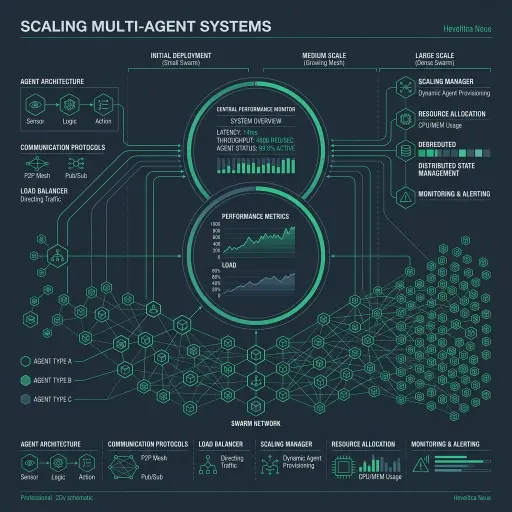
As businesses move toward Agentic Workflows, a new architectural challenge emerges: how do you manage a "swarm" of autonomous agents without degrading the system's core performance? In a Multi-Agent Portal, the complexity isn't just in the logic of one agent, but in the orchestration and performance of many.
The Invisible Overhead of Autonomy
In a traditional request-response model, the load is predictable. In an agentic model, a single user click might trigger a chain reaction of four or five agents performing asynchronous tasks—from scanning inventories to calculating dynamic pricing.
This leads to the Concurrency Spike Paradox: more agents provide more value, but they also create more "noise" in your event loop.
Architecting for Response, Not Just Completion
At BWS, we follow three core principles when scaling these invisible agents:
1. Decoupled Task Orchestration
We never allow agents to run directly on the main application thread. Instead, we leverage Redis-backed message queues. When an agent is triggered, its work is serialized and placed in a queue. This ensures that the user's dashboard remains buttery smooth while the agent "thinks" in the background.
2. The "Optimistic Update" UX
When an agent starts a task (like booking a flight across multiple GDS providers), we don't make the user wait for a final "Success" message. We use Optimistic UI patterns combined with real-time Webhook updates. The user sees a "Processing..." state immediately, and the UI updates granularly as each agent completes its sub-task. This eliminates the "perception of slowness."
3. State Management in the Fog
In a distributed agentic system, "State" is often fragmented. We implement a central State Synchronizer that acts as the single source of truth. As agents finish their work, they report to this synchronizer, which then broadcasts the update to the frontend via WebSockets. This ensures that even if agents finish out of order, the user sees a coherent, chronological outcome.
Performance as a Foundation
Scaling isn't about throwing more CPU at the problem. It’s about managing the flow of information so that the user never feels the complexity sitting behind the interface.
By prioritizing Throughput and Latency Management, we build portals that can handle thousands of concurrent agents while maintaining the responsiveness of a simple static site.
Conclusion
The future of enterprise software is autonomous, but that autonomy cannot come at the cost of stability. Whether you are building a flight booking engine or a complex inventory auditor, your architecture must be as resilient as the agents it serves.
Interested in our approach to high-scale agentic systems? Explore our API Development services or read our Flight Booking Portal case study to see these principles in action.