If your EdTech platform only serves PDFs and streams pre-recorded lectures, you haven't built an educational platform; you've built an inefficient competitor to YouTube.
The next generation of Learning Management Systems (LMS) isn’t defined by static content repositories, but by dynamic, bidirectional interaction models driven by data science.
The Failure of the "One-Size" Curriculum
Traditional classrooms force 30 students to learn at the exact pace of the median outlier. Early LMS logic replicated this by creating linear, locked courses. Everyone watches Video A, takes Quiz B, and moves to Module C. If a student instantly masters Module A, forcing them to sit through it breeds boredom. Conversely, if a student struggles intensely with Module B, pushing them into Module C ensures catastrophic failure later.
Introducing the Adaptive Engine
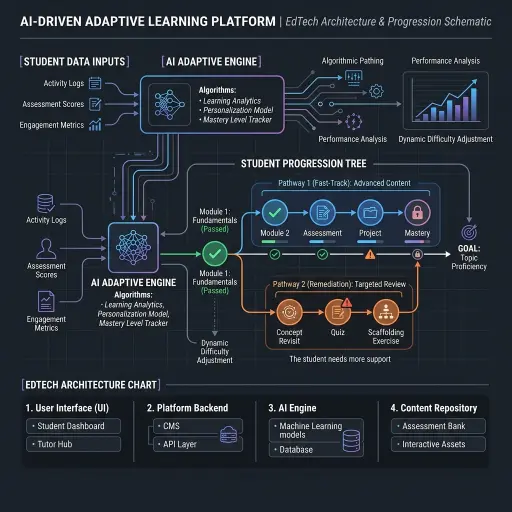
Adaptive learning algorithms leverage machine learning to re-route a student's curriculum in real-time based on their micro-interactions.
- Micro-Assessments: Standardized testing is replaced with continuous micro-evaluations. The time it takes a student to answer, the specific distractor option they chose when they got it wrong, and their historical performance on related ontology nodes provide deep telemetry.
- Dynamic Branching: If the system detects a student struggling with basic algebra logic during a physics module, it can autonomously pause the physics progression and inject a micro-lesson on the prerequisite math before allowing them to proceed.
Peer-to-Peer and the "Human" Loop
AI cannot replace empathy. The goal of an advanced LMS isn't to remove the teacher, but to superpower them. By aggregating these learning paths into a centralized dashboard, tutors can log in in the morning and instantly see: "Student A was stuck on node 4 at 2:00 AM." Instead of spending 40 minutes delivering a lecture to the whole class, they can spend 5 minutes delivering a highly targeted, emotional intervention to Student A.
Conclusion
As broadband access democratizes globally, the differentiator in EdTech isn't access to content—it is the efficiency of knowledge transfer. The platforms that succeed over the next five years will be the ones that bend the curriculum to the student, rather than forcing the student to bend to the curriculum.