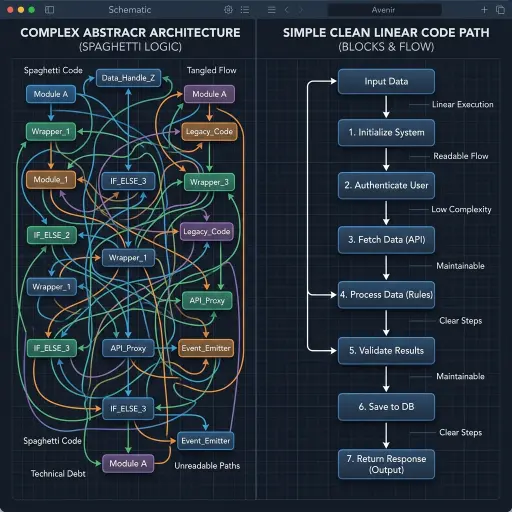
We have all encountered the "10x Developer" who takes a perfectly functional, straightforward function and refactors it into a deeply nested hierarchy of abstract factory patterns. To them, the code has been "cleaned." To the junior developer onboarding six months later, the code has become a labyrinth of indirection.
This is the Clean Code Fallacy: the dangerous belief that theoretical architectural perfection equates to business value.
The Cost of Abstraction
Abstraction is a powerful tool designed to hide complexity. But every layer of abstraction you introduce inherently increases the cognitive load required to understand the full path of execution.
Consider a standard e-commerce calculation.
- The "Ugly" Approach: A single 100-line controller that verifies stock, calculates tax, deducts a coupon, and returns a total. It's procedural, mildly repetitive, completely un-elegant, and instantly understandable by any developer who reads it top-to-bottom.
- The "Clean" Approach: A master
PricingEngineclass injecting aTaxStrategyinterface, aDiscountDecoratorarray, and firing decoupled events into an observer bus. Mathematically beautiful. Totally decoupled. But tracing a simple pricing bug now requires jumping through twelve distinct files to construct the mental model.
Code is meant to be Read, Not Admired
The ultimate metric for code quality isn't how well it adheres to SOLID principles or DRY (Don't Repeat Yourself). The ultimate metric is Maintanability: How fast can a completely new developer find a bug, understand the context, fix it, and deploy it without breaking unrelated systems?
Sometimes, duplicating 10 lines of code across two controllers is significantly healthier for the lifetime of a project than extracting those lines into a hyper-abstract SharedUtility class that tightly couples the two logic flows together.
Pragmatic Engineering Boundaries
This is not an excuse to write messy, unstructured spaghetti code. It is an argument for pragmatism.
- Wait for the Rule of Three: Do not extract logic into a reusable abstraction the second time you write it. Wait for the third time. The second occurrence is often a coincidence; the third establishes a pattern.
- Optimize for Deletion: Build systems in isolated modules so that when a feature inevitably fails market testing, you can delete the folder without untangling it from the core project's deep interfaces.
Summary
Software engineering is a business discipline, not an ivory-tower academic pursuit. At BWS, we write code to solve business problems efficiently and robustly. When forced to choose between a "clever" one-liner and a "boring" standard approach, we choose boring every time. Boring software scales.