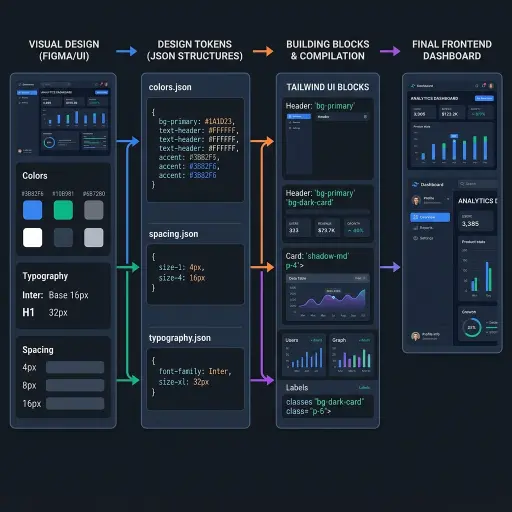
The relationship between designers and developers has historically been defined by friction. Designers dream in abstract variables—shadow depths, brand hues, typography scales—while developers think in rigid DOM structures and specific CSS properties. Bridging this gap isn’t just about communication; it’s about establishing a singular, programmatic source of truth.
The Problem with Handoff Constraints
When a designer hands over a Figma file without a programmatic token system, developers resort to hardcoding values. You end up with CSS files littered with #1A2B3C hex codes instead of semantic references like color-primary-600.
When the client decides the brand needs to shift from a cool navy to a vibrant emerald, developers spend hours "Find-and-Replacing" color codes, inevitably missing edge cases and creating technical debt.
What are Design Tokens?
Design tokens are the atomic elements of visual design represented as raw data (typically JSON). Instead of saying "the button is blue," a token states action.background.primary: #2563EB.
When the underlying hex code changes, the token value updates. Every system that subscribes to that token—from an iOS Swift App to a React Web Dashboard—inherits the change automatically.
The Tailwind Integration
Frameworks like Tailwind CSS have popularized utility-class architecture. By mapping our JSON design tokens directly into the tailwind.config.js theme extension, we create an unbreakable bond between the Figma canvas and the React component.
// tailwind.config.js
module.exports = {
  theme: {
    extend: {
      colors: {
        primary: {
          500: 'var(--token-brand-primary-500)',
        }
      }
    }
  }
}
Now, when a developer writes <button className="bg-primary-500">, they aren't painting the button blue. They are subscribing the button to the primary-500 token.
Conclusion
By treating your design system as an API endpoint, you eliminate "pixel-pushing." Frontend engineers shouldn't be matching colors with an eyedropper tool; they should be connecting semantic UI components to deeply integrated, headless token architectures. That is where premium software velocity is truly unlocked.