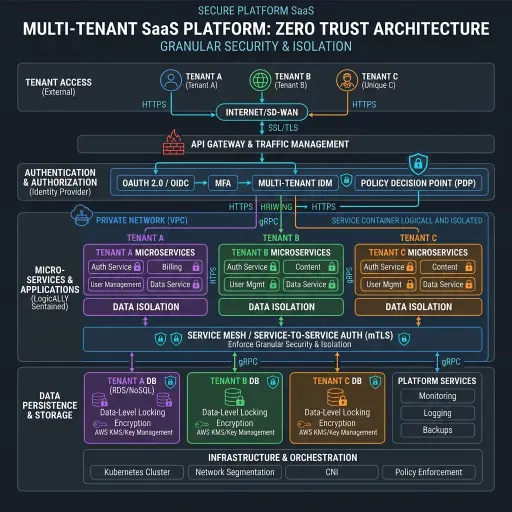
In a Multi-Tenant SaaS platform, your codebase is inherently dangerous. You are housing the completely isolated business data of hundreds (or thousands) of distinct companies within the exact same database engine.
A single missing WHERE tenant_id = ? clause in a complex SQL query doesn't just cause a bug; it causes an immediate, catastrophic data breach. At BWS, we engineer security not as an external firewall, but as the fundamental DNA of the data access layer.
The Death of the "Perimeter"
Historically, companies built massive firewalls (the perimeter) and assumed everything inside the network was safe. This is fundamentally obsolete. If a malicious actor compromises an internal service, or if an SSRF vulnerability allows an attacker to pivot internally, the entire castle falls.
Zero Trust Architecture means that every microservice inside your VPC treats every other microservice as hostile until explicitly authenticated. Traffic between your internal billing service and your internal user service should be mutually authenticated (mTLS) and encrypted, even though they sit right next to each other on the server rack.
Data Isolation Patterns
How do you prevent Tenant A from seeing Tenant B's data?
- Silo Isolation (Database per Tenant): The safest, but most expensive and hardest to scale. Every client gets their own database instance. Heavy enterprise clients often demand this.
- Pool Isolation (Row-Level Security): All tenants share the same tables, identified by a
tenant_idforeign key. While highly efficient, this relies entirely on application-level logic to filter data.
The Hybrid Approach (PostgreSQL RLS):
Modern databases allow us to bind the isolation into the database engine itself rather than relying on application code. Using PostgreSQL's Row-Level Security (RLS) policies, we can establish rules at the infrastructure layer: CREATE POLICY isolate_tenant ON orders USING (tenant_id = current_setting('app.current_tenant')::uuid);
Even if a developer makes a mistake in the API layer and runs SELECT * FROM orders, the database engine intercepts the query and physically limits the return array to the active tenant's context.
Encryption at Rest and Key Management
If a database snapshot is leaked, the payload must remain worthless. While AWS RDS offers native disk-encryption, you must also employ application-level encryption for High-PII (Personally Identifiable Information) like medical records or API tokens using key-management systems (KMS).
Conclusion
"Security by design" means removing the human element from vulnerability wherever possible. You do not ask developers to remember to append isolation keys; you enforce it at the database policy layer. You do not trust internal IP addresses; you enforce cryptographic verification. When security is the baseline architecture, scaling becomes exponential and fearless.